
Impact Test Experiment
Introduction
Engineering materials are often subjected to sudden or rapidly applied loads during service. Unlike gradually applied static loads, impact loads act over a very short duration and may cause unexpected failure. Therefore, it is important to evaluate the ability of a material to absorb energy under impact loading.
The Izod Impact Test is a standard method used to determine the impact toughness of a material. In this test, a standard notched specimen is fractured by a single blow from a swinging pendulum hammer. The energy absorbed in breaking the specimen is a measure of its resistance to impact.
Physical Concept
In the Izod impact test, a pendulum of known weight is released from a fixed height, as shown in Figure 1.
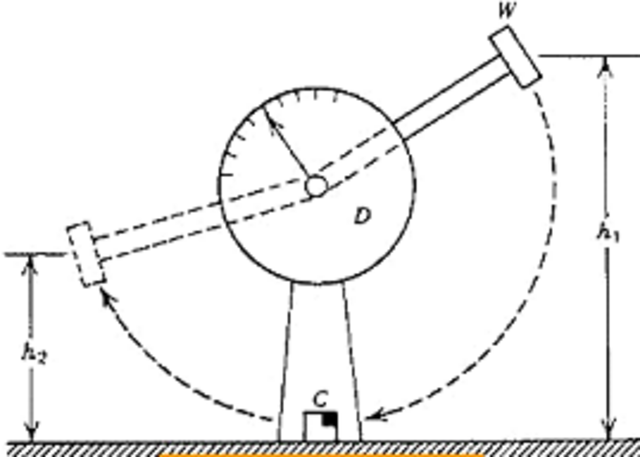
The pendulum swings downward under the action of gravity and strikes the notched specimen. A portion of the pendulum's potential energy is absorbed in fracturing the specimen, while the remaining energy carries the pendulum upward to a lower height.
The difference between the initial and final potential energies represents the energy absorbed by the specimen during fracture.
Everyday Intuition
Impact loading is encountered in many practical situations, such as:
- A hammer striking a nail.
- Vehicle collisions.
- Falling rocks impacting structures.
- Railway wheels passing over rail joints.
- Machine components subjected to sudden shocks.
In each case, the material must withstand rapidly applied loads without catastrophic failure.
Experimental Relevance
The Izod impact test is performed to determine the ability of a material to absorb energy during sudden loading.
The test helps determine:
- Impact energy absorbed
- Impact toughness (impact strength)
- Resistance to shock loading
- Fracture behaviour of materials
These properties are important for selecting materials used in bridges, buildings, machine components, pressure vessels, automobiles, and other structures subjected to dynamic loading.
Apparatus and Working Principle
The experiment is performed using an Izod Impact Testing Machine.
The major components are:
- Pendulum hammer
- Rigid support frame
- Specimen holder
- Graduated energy scale
- Pointer mechanism
- Release mechanism
The notched specimen is clamped vertically in the specimen holder with the notch facing the hammer. The pendulum is raised to a predetermined height and released without any initial velocity.
As the hammer strikes the specimen, part of its kinetic energy is absorbed in fracturing the specimen. The remaining energy causes the pendulum to rise to a lower height on the opposite side.
The absorbed energy is indicated directly on the machine scale.
Mathematical Formulation
The potential energy of the pendulum before impact is
After fracturing the specimen, the pendulum rises to a lower height, and its remaining potential energy is
Therefore, the energy absorbed by the specimen is
where
- = Energy absorbed during fracture
- = Weight of the pendulum
- = Initial height of the pendulum
- = Height reached after fracture
The impact toughness of the material is commonly reported as the energy absorbed during fracture. In some cases, it may also be expressed as energy absorbed per unit cross-sectional area at the notch.
Effect of the Notch
The specimen contains a standard notch that acts as a stress concentrator.
The notch:
- Produces a localized high-stress region.
- Promotes crack initiation at a known location.
- Ensures repeatable and comparable test results.
Without the notch, fracture may occur at an unpredictable location.
Ductile and Brittle Behaviour
Ductile Materials
Examples:
- Mild steel
- Aluminium
- Copper
Characteristics:
- Absorb large amounts of impact energy.
- Undergo noticeable plastic deformation before fracture.
- Exhibit high impact toughness.
Brittle Materials
Examples:
- Cast iron
- Glass
- Concrete
Characteristics:
- Absorb relatively little impact energy.
- Fracture suddenly with little or no plastic deformation.
- Exhibit low impact toughness.
Engineering Significance
Impact testing is widely used to evaluate the suitability of engineering materials for applications involving shock or dynamic loading.
The experimental results help engineers:
- Select materials for impact-resistant structures.
- Evaluate the toughness of structural steels.
- Compare the dynamic behaviour of different materials.
- Ensure safety against sudden loading conditions.
- Assess material quality and compliance with engineering standards.
Impact testing is therefore an important tool in material selection for transportation, construction, manufacturing, and structural engineering applications.