
Demonstrate Session Management Procedures
1. Introduction to Session Management in 5G
The introduction of the 5G Core (5GC) network has transformed how mobile networks handle user data sessions. Unlike 4G, where connectivity is based on EPS bearers, 5G uses a more flexible, service-based concept called PDU Sessions. These PDU sessions form a logical connection between the User Equipment (UE) and a Data Network (DN) such as the internet, IMS, or enterprise cloud.
Behind every PDU session, the Session Management Function (SMF) acts as the central decision-maker. It controls the complete lifecycle of the user session, including session creation, modification, QoS handling, and release. SMF works closely with the AMF, UPF, PCF, and UDM using HTTP/2 based SBA communication, delivering a cloud-native and highly scalable architecture.
The entire session management framework enables the network to deliver efficient data routing, traffic handling, dynamic QoS, and seamless mobility for every subscriber in the 5G network.
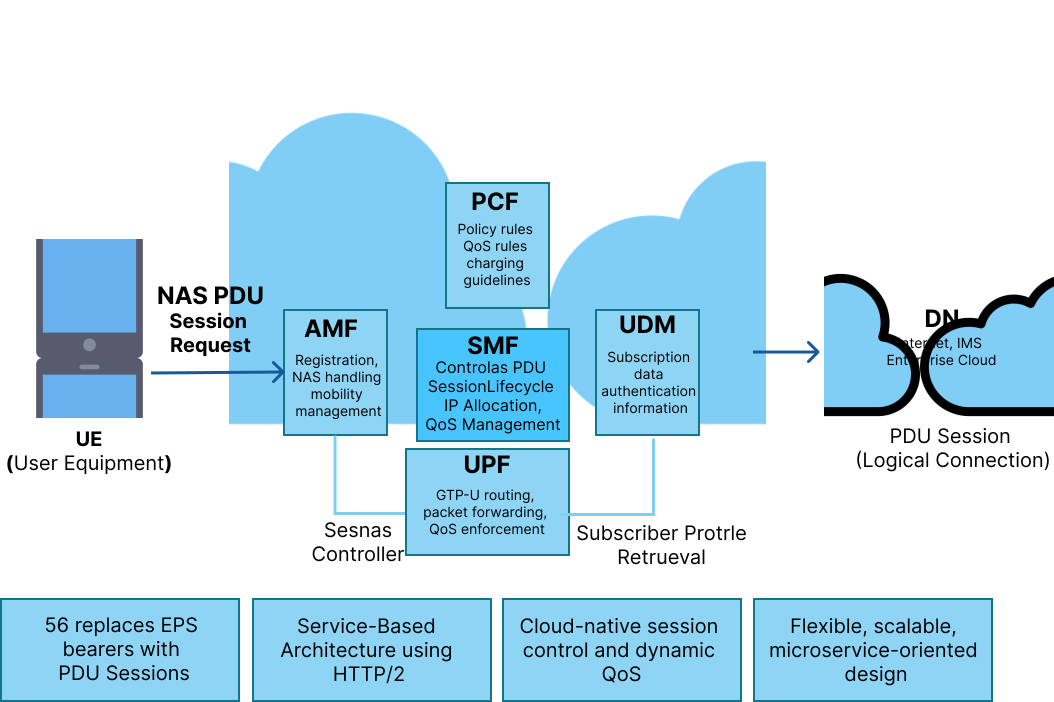
Fig: Session management in 5G core (5GC)
2. 5G Core Architecture for Session Management
In the 5G Service-Based Architecture (SBA), Session Management involves the interaction of multiple network functions:
Network Functions Involved
- AMF (Access and Mobility Management Function): Handles registration, mobility, reachability, and NAS signaling. It receives PDU session requests from UE and forwards them to SMF.
- SMF (Session Management Function): The central controller that manages PDU session establishment, modification, and release. It selects UPF, allocates IP addresses, retrieves policies, and configures QoS.
- UPF (User Plane Function): Routes user traffic using GTP-U on N3. It performs packet forwarding, QoS enforcement, traffic reporting, and data network interfacing.
- PCF (Policy Control Function): Provides QoS policies, charging rules, and traffic steering information required during session setup.
- UDM (Unified Data Management): Supplies subscription data, allowed DNNs, slice profiles, and authentication information.
- NRF (Network Repository Function): Helps AMF discover suitable SMF instances for selected slices.
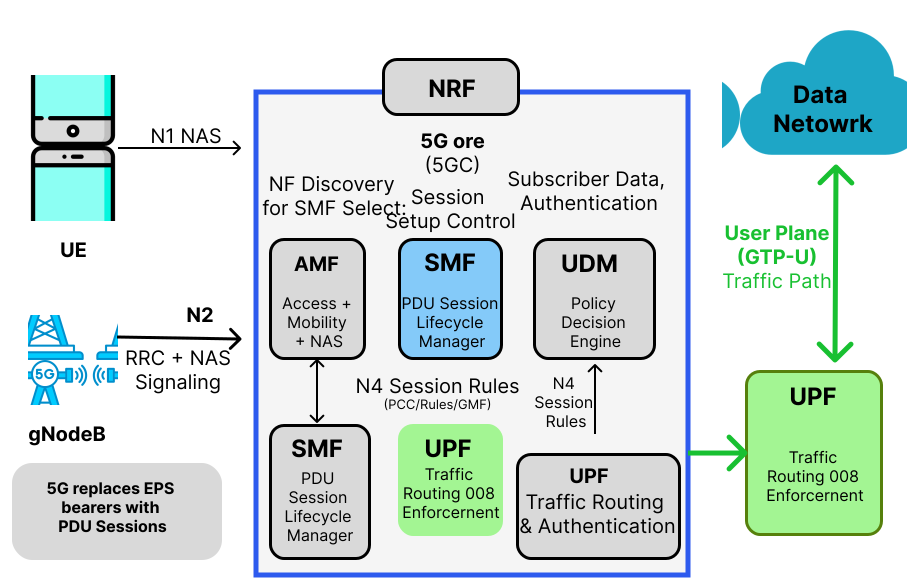
Fig: 5G core architecture for Session management
3. PDU Session Concepts
A PDU session is a logical connection between the UE and a Data Network that provides connectivity services. Each PDU session is characterized by several parameters:
- PDU Session Identifier: A unique identifier assigned by the UE to distinguish between multiple PDU sessions.
- S-NSSAI (Single Network Slice Selection Assistance Information): Identifies the network slice in which the PDU session is established, enabling network slicing capabilities.
- DNN (Data Network Name): Specifies the Data Network to which the PDU session provides connectivity, similar to APN in 4G (e.g., "internet", "ims").
- PDU Session Type: Defines the end-user protocol carried by the PDU session - IPv4, IPv6, dual-stack IPv4/IPv6, Ethernet, or Unstructured.
- SSC Mode (Session and Service Continuity Mode): Determines the longevity of the User Plane anchor point and whether it can be reallocated during mobility.
- QoS Flows: Within each PDU session, multiple QoS flows can be established with different Quality of Service characteristics. For example, one QoS flow for IMS signaling and another for voice call data.
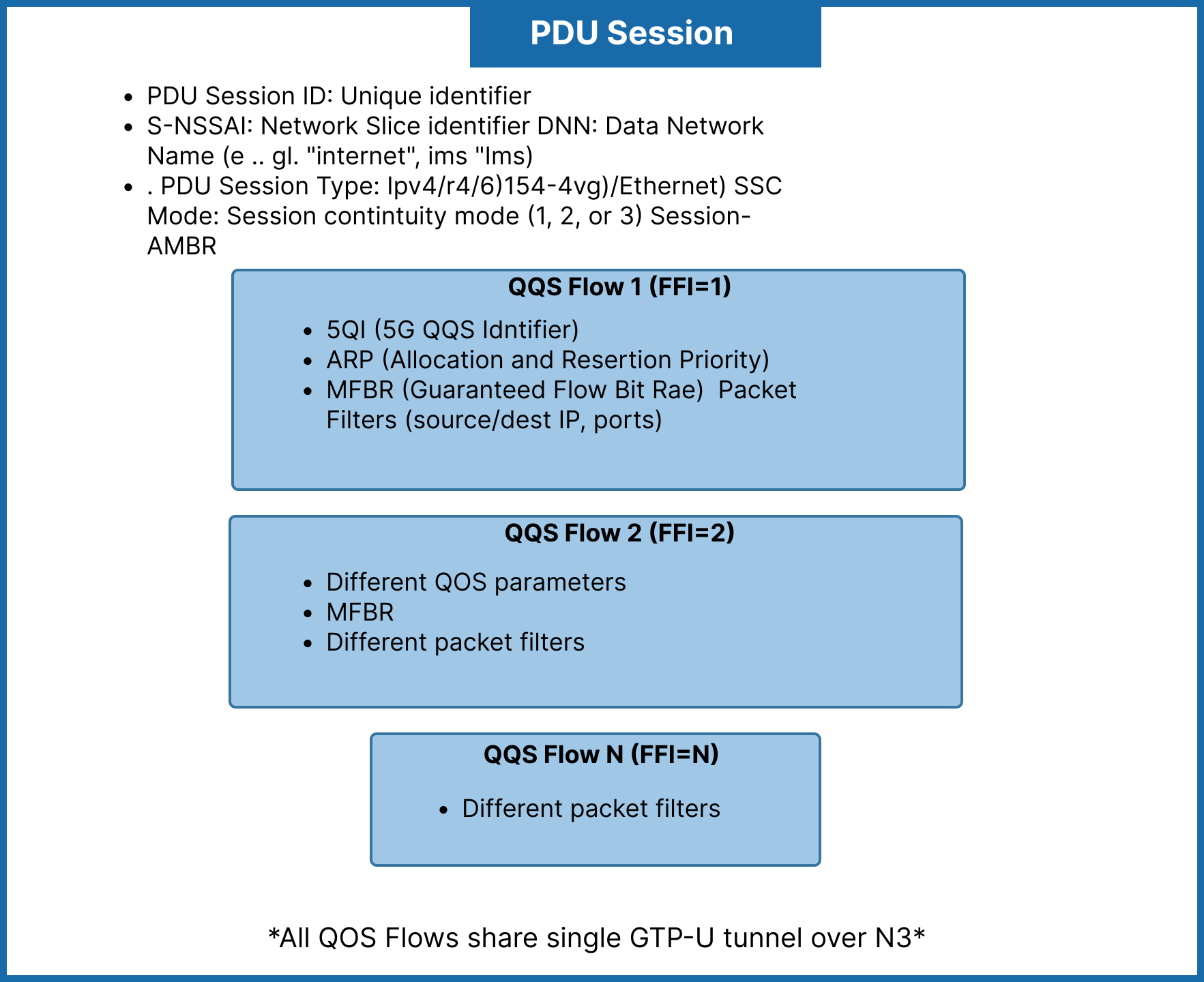
Fig: PDU Session Structure
4. PDU Session Establishment Process
The UE-requested PDU session establishment is a multi-step procedure involving several network functions working in coordination. The detailed call flow is described below:
UE Initiates Request: The UE sends a NAS (Non-Access Stratum) message containing a PDU Session Establishment Request to the AMF. This message includes critical information such as PDU Session ID (generated by UE), S-NSSAI (network slice identifier), DNN (Data Network Name), Request Type (initial/existing/emergency), and N1 SM container with session management parameters.
AMF Processing: The AMF receives and validates the request. It determines whether the PDU session can be established based on subscription data, network policies, and available resources. For roaming scenarios, AMF determines if Local Breakout (LBO) or Home Routing should be used.
SMF Selection: AMF selects an appropriate SMF instance based on multiple criteria including network slice, requested DNN, UE subscription data, load balancing considerations, and geographic location. The AMF uses NRF for SMF discovery and selection.
Create SM Context Request: AMF sends a Create SM Context Request to the selected SMF, forwarding all relevant information including SUPI (Subscription Permanent Identifier), PDU Session ID, S-NSSAI, DNN, AMF ID, Request Type, PCF ID, Priority Access, and User Location Information.
SMF Registration and Subscription Retrieval: If the SMF hasn't handled this session before, it registers with UDM for the PDU session. SMF retrieves user subscription data from UDM, including default PDU session policies, QoS parameters, allowed DNN list, and network slice information.
Policy Retrieval: SMF contacts PCF to obtain policy and charging control (PCC) rules specific to this PDU session. PCF provides QoS policies, charging rules, traffic steering policies, and session management policies.
UPF Selection and Session Establishment: SMF selects an appropriate UPF based on UE location, DNN, network topology, and load distribution. SMF allocates an IP address for the UE from the IP address pool associated with the DNN.
N4 Session Establishment: SMF sends an N4 Session Establishment Request to the selected UPF, providing Packet Detection Rules (PDR), Forwarding Action Rules (FAR), QoS Enforcement Rules (QER), and Usage Reporting Rules (URR). The UPF acknowledges with N4 Session Establishment Response confirming the session setup.
Create SM Context Response: SMF responds to AMF with Create SM Context Response containing PDU Session ID, QoS Flow Identifier (QFI), QoS Profile (5QI, ARP, bit rates), N2 SM information for RAN, CN Tunnel Info (F-TEID), and Session-AMBR (Aggregate Maximum Bit Rate).
RAN Resource Setup: AMF sends N2 PDU Session Resource Setup Request to the RAN (gNodeB) with the N2 SM information received from SMF. RAN allocates radio resources for the PDU session and establishes the user plane path.
RAN to UE Signaling: RAN exchanges RRC (Radio Resource Control) signaling with UE to configure the radio bearers and establish the data radio bearer (DRB) for the PDU session.
PDU Session Acceptance: RAN confirms successful resource setup to AMF through N2 PDU Session Resource Setup Response. AMF forwards PDU Session Establishment Accept message to UE via RAN, including allocated IP address, accepted QoS parameters, Session-AMBR, authorized QoS rules, selected PDU session type, and selected SSC mode.
User Plane Activation: With all signaling complete, the user plane path is now established end-to-end from UE through RAN, UPF, to the Data Network. The UE can now begin sending and receiving data traffic using the allocated IP address.
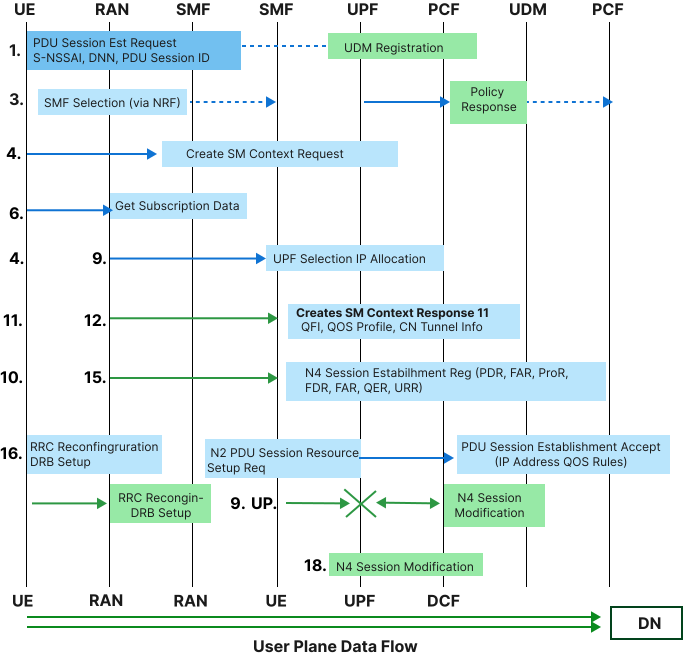
Fig: PDU Session Establishment Call Flow
5. Session Management Messages
PDU Session Establishment Request contains PDU session type (IPv4/IPv6/IPv4v6/Ethernet/Unstructured), SSC mode (1/2/3), 5GSM capability (Reflective QoS support, Multi-homed IPv6 support), Maximum number of supported packet filters, Always-on PDU session indicator, Extended protocol configuration options, and Request Type (initial/existing/emergency).
PDU Session Establishment Accept includes Selected PDU session type, Selected SSC mode, Authorized QoS rules (QoS Rule ID, precedence, packet filters, QFI), Session-AMBR (downlink and uplink), PDU address (allocated IP address), Authorized QoS flow descriptions (QFI, 5QI, GFBR, MFBR), DNN (Data Network Name), S-NSSAI (network slice), and Extended protocol configuration options (DNS addresses, P-CSCF addresses).
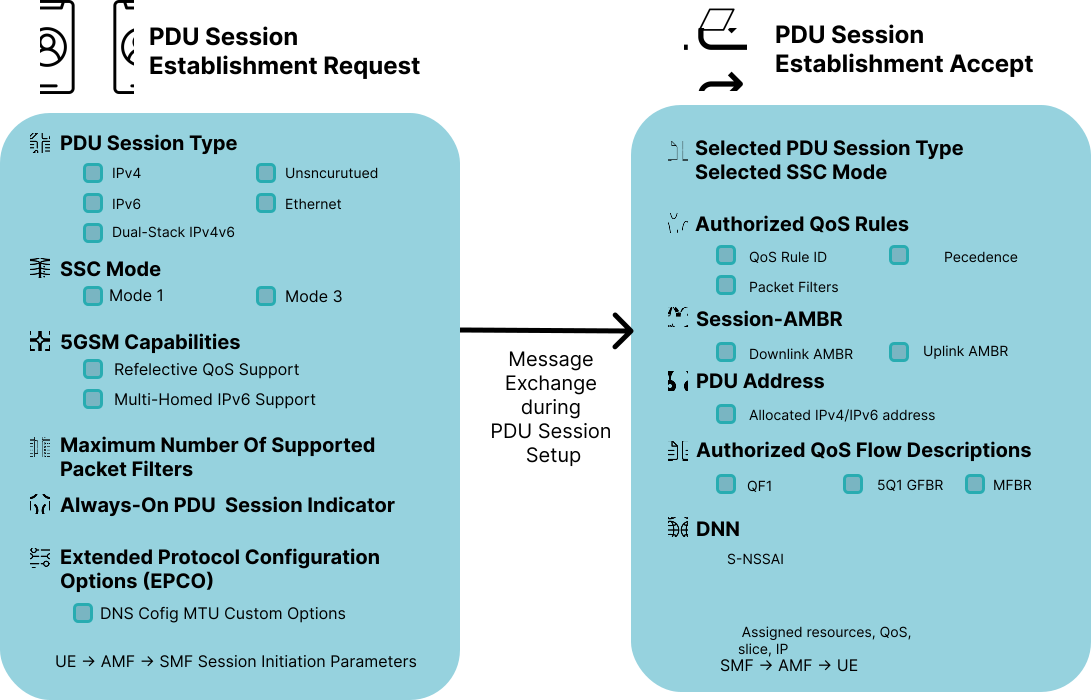
Fig: 5G Session Management Messages – PDU Session Establishment Request & Accept
6. QoS Management
Quality of Service in 5G is managed through QoS Flows within PDU sessions. Each QoS flow is identified by a QFI (QoS Flow Identifier) and characterized by 5QI (5G QoS Identifier), which defines standardized QoS characteristics including resource type (GBR/Non-GBR), priority level, packet delay budget, and packet error rate.
Reflective QoS: A mechanism where UE derives uplink QoS rules from downlink QoS treatment without explicit signaling, reducing signaling overhead.
7. Session Modification and Release
Session Modification
Session Modification is triggered when:
- Application requires higher/lower bandwidth
- PCF updates policy
- RAN changes radio capability
- UE requests new QoS flow
- Network applies traffic steering
SMF updates:
- QoS rules
- PDRs
- QERs
- IP rules
- Tunnel parameters
and informs AMF/RAN accordingly.
Session Release
Session release can be triggered by:
- UE: PDU Session Release Request
- Network: Policy or resource optimization
- Timeout: Inactivity timer expiration
- RAN: Radio link failure