
Verification of Bernoulli's equation 
Theory:
Fluid motion is governed by the fundamental laws of mass, momentum, and energy conservation. Among these, Bernoulli’s principle is one of the most widely applied concepts in fluid mechanics and aerodynamics. Formulated by Daniel Bernoulli, a Swiss mathematician, in the 18th century, the principle provides a direct relationship between the pressure, velocity, and elevation of a fluid in motion.
Formal Statement:
Bernoulli’s equation is a statement of Newton’s second law of motion and energy conservation for an inviscid, incompressible flow as it can be derived from the momentum equation and the general energy equation. Bernoulli's principle states that an increase in the speed of a fluid occurs simultaneously with a decrease in static pressure or a decrease in the fluid's potential energy. It can also be stated as: for an ideal fluid with no work being performed on the fluid, total energy remains constant. The Bernoulli’s equation contains some assumptions which are; steady, inviscid, incompressible, and along a streamline or irrotational, and it can only be applied if the flow satisfies these conditions.
Mathematical Description:
From incompressible continuity equation,
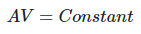 (1)
(1)
 (2)
(2)
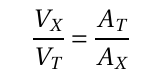 (3)
(3)
From Bernoulli's equation,
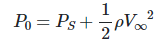 (4)
(4)
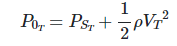 (5)
(5)
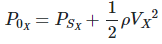 (6)
(6)
From eq. (5) and eq. (6),
 (7)
(7)
Where,
A - Duct area
V - Velocity of fluid
P0 - Total pressure
PS - Static pressure
ρ - Density of fluid
Subscript
X - Particular location in duct
T - Throat of duct
∞ - Freestream