
Stretch Forming
Introduction
Stretch forming is a metal forming process in which sheet metal is stretched and bent simultaneously over a die to produce large contoured parts. The sheet is gripped along its edges by gripping jaws, which are pulled by pneumatic or hydraulic force on a stretch press. The sheet is then wrapped over a stretch form block (form die) to achieve the desired contour.
The most common stretch presses are:
- Vertical stretch presses – the form die is raised into the sheet using a hydraulic ram.
- Horizontal stretch presses – the form die is fixed, and jaws pull the sheet horizontally around it.
As the sheet stretches, tensile forces increase and the metal undergoes plastic deformation, taking the shape of the die.
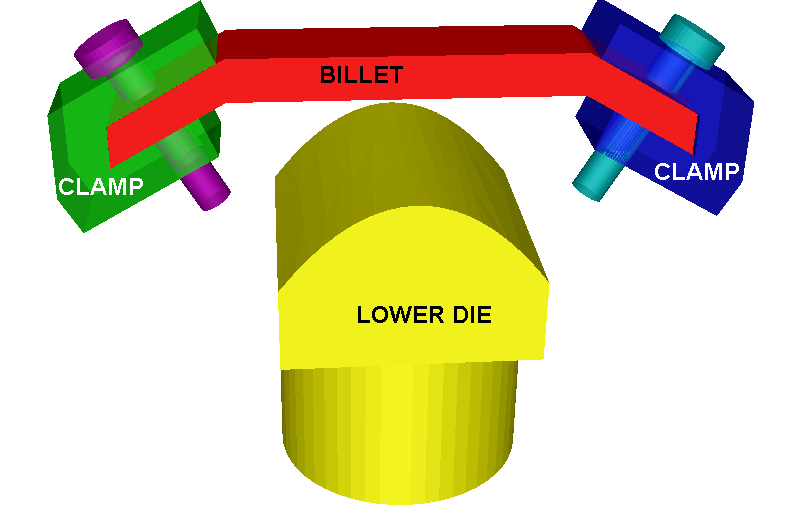
Figure: Stretch Forming
Precision and Capabilities
Stretch forming is known for its high accuracy and precision, making it suitable for producing:
- Intricate multi-component assemblies
- Snap-together curtain wall components
- Smooth, uniform, and ripple-free surfaces
- Large-radius bends and complex curved profiles
Shapes possible include:
- Portions of circles
- Ellipses
- Parabolas
- Arched shapes
- Curved surfaces with straight legs
This reduces additional fabrication steps such as welding and bending.
Working Principle
The process involves stretching a metal piece over a male stretch form block (STFB) using a hydraulic or pneumatic stretch press.
The sheet is not drawn into the die (unlike deep drawing). Instead, it is stretched with uniform thinning and elongation.
Materials Used
Ductile materials are preferred:
- Aluminium
- Steel
- Titanium
Applications
Stretch formed parts are typically large curved components, such as:
- Aircraft wing panels
- Automotive door and body panels
- Window systems and skylights
- Storefronts and curtain walls
- Hand railings and walkway enclosures
- Signs and architectural frameworks
- Window frames and enclosures
Benefits:
- Close and consistent tolerances
- No surface distortion, ripples, or marring
- Smooth and even surface finish
- Suitable for large aluminium, stainless steel, and titanium parts
- Quick and highly repeatable
Types of Stretch Forming
1. Sheet Stretch Forming
Used extensively in:
- Manufacturing aircraft fuselage skin sections
- Aerospace-grade aluminium alloy sheets
2. Extrusion Stretch Forming
Used for:
- Contouring aluminium aerospace extrusion profiles
- Roll-formed profiles
- Press-braked shapes
These presses are also known as stretch wrap or swing arm presses.
They use:
- Two swinging arms
- Multiple gripping jaws
- Hydraulic tension cylinders to stretch and wrap the workpiece around the die