
Searching and Sorting
Searching and sorting are foundational concepts in computer science and problem solving. They are essential for efficiently organizing, accessing, and processing data in a wide range of applications—from databases and search engines to scientific computing and everyday software.
Why Searching and Sorting?
Sorting data allows us to use efficient searching algorithms and solve complex problems more easily. For example, searching for a value in a sorted list can be done much faster than in an unsorted one.
Sorting: The Merge Sort Example
One of the most efficient and widely used sorting algorithms is merge sort. Merge sort works by recursively dividing the list into halves, sorting each half, and then merging the sorted halves back together. This process is visualized below:
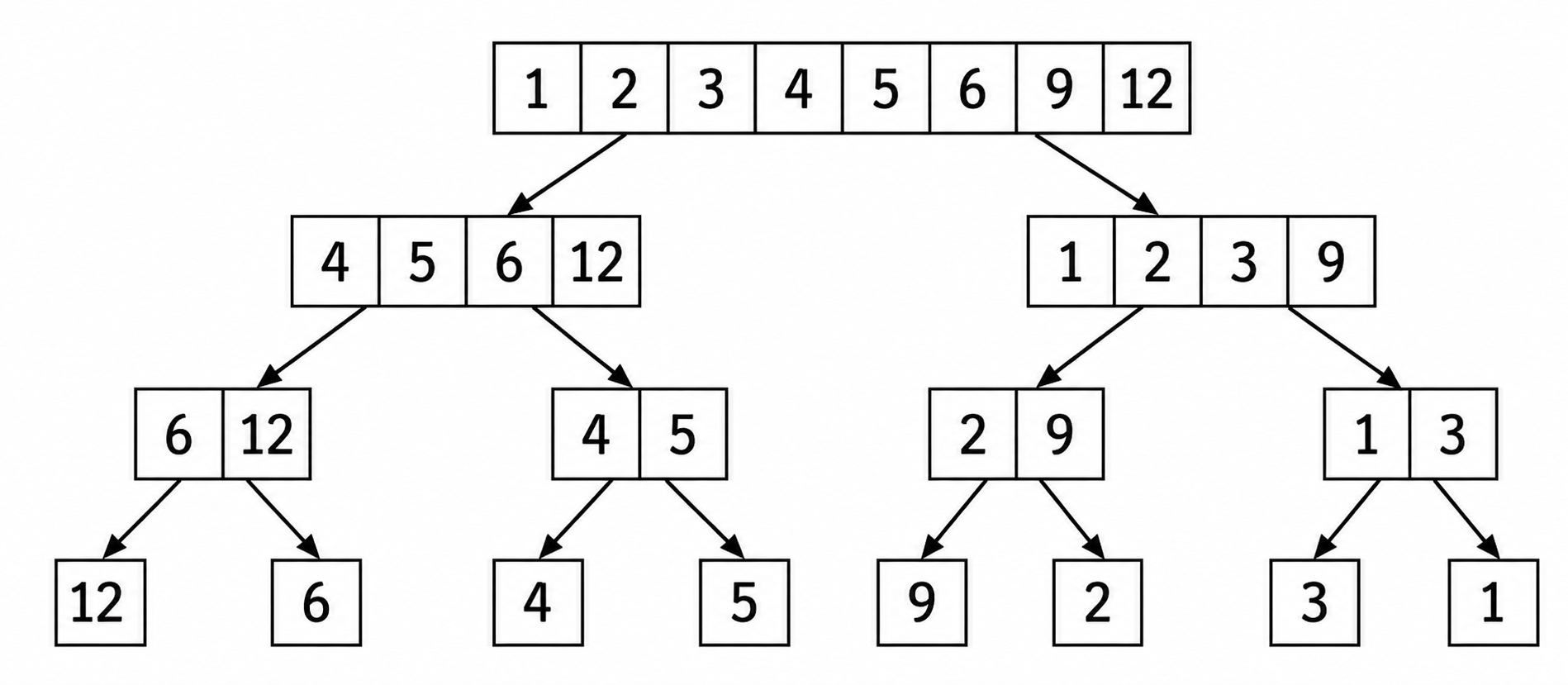
Figure: Merge sort recursively splits and merges the array to sort it efficiently.
Merge sort is an example of a divide and conquer algorithm. It is efficient for large datasets and guarantees a time complexity of .
Searching
Searching is the process of finding a specific item or value within a collection of data. Common searching algorithms include:
- Linear Search: Checks each element one by one. Simple but slow for large data.
- Binary Search: Works on sorted data, repeatedly dividing the search interval in half. Much faster than linear search.
Example:
Suppose you have a sorted list: [2, 5, 8, 12, 16, 23, 38, 56, 72, 91]
To find 23 using binary search:
- Compare with the middle element (16). 23 > 16, so search right half.
- Next middle is 38. 23 < 38, so search left half.
- Next middle is 23. Found!
Problems You Will Solve
In this experiment, you will solve two main problems that require searching and sorting as key steps:
1. Triangle Problem
Task: Given a set of numbers, determine how many combinations cannot form a triangle. Sorting helps in efficiently checking combinations.
Hint: For three numbers , they cannot form a triangle if , , or . Sorting the numbers allows you to check these conditions efficiently, often using binary search.
2. Substring Problem
Task: Given a string and a set of characters, find the shortest substring containing all characters from the set. Searching and tracking positions are crucial for an efficient solution.
By mastering these techniques, you will be able to tackle a wide range of computational problems more effectively. The skills you learn here are foundational for advanced topics in algorithms and data structures.