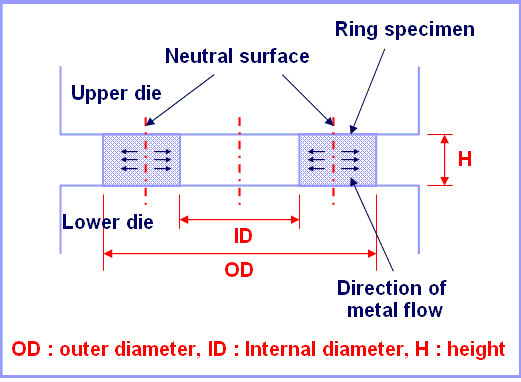
Ring compression test has been widely used to evaluate friction conditions in metal forming processes.
THE PRINCIPLE OF RING TEST
For given conditions of temperature, strain, strain rate and initial geometry (OD:ID:H),
the deformation of internal diameter can be calculated as a function of friction coefficient.
Geometrical Change and Friction Condition
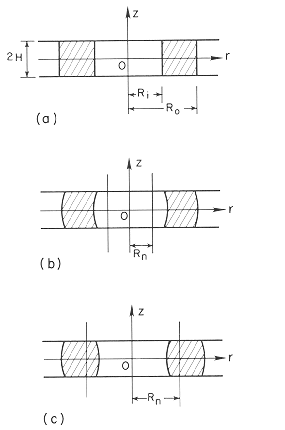
When a short ring specimen is compressed, internal diameter increases at low friction and decreases at high friction.
By measuring the change in ID, friction conditions can be evaluated using calibration curves.
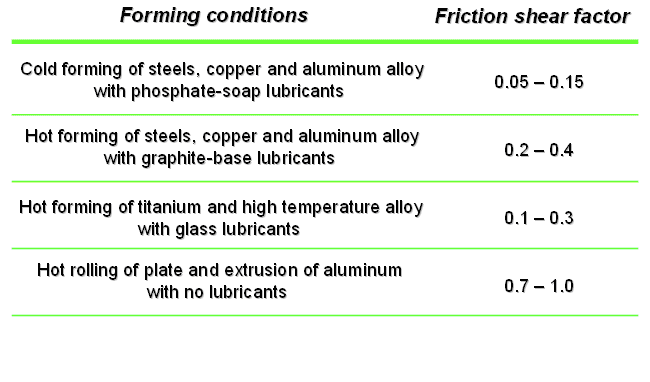
For various forming conditions, the value of “m” varies as follows:
CASE A : RING TEST SIMULATION FOR M = 0.0
Material
: AlZn5.6Mg2.5Cu1.6
Friction Shear Factor
: m = 0.0
Dimensions
: OD = 60mm, ID = 30mm, Height = 20mm
Ring Temperature
: 300°C
Die Temperature
: 250°C
% Reduction in Height
: 50% (10 mm)
Simulation Results
Final ID
: 42.0989 mm
% Decrease in ID
: -40.3297%
% Reduction in Height
: 50%
CASE B : RING TEST SIMULATION FOR M = 0.10
Material
: AlZn5.6Mg2.5Cu1.6
Friction Shear Factor
: m = 0.10
Dimensions
: OD = 60mm, ID = 30mm, Height = 20mm
Ring Temperature
: 300°C
Die Temperature
: 250°C
% Reduction in Height
: 50% (10 mm)
Simulation Results
Final ID
: 34.5300 mm
% Decrease in ID
: -15.1000%
% Reduction in Height
: 50%
CASE C : RING TEST SIMULATION FOR M = 0.30
Material
: AlZn5.6Mg2.5Cu1.6
Friction Shear Factor
: m = 0.30
Dimensions
: OD = 60mm, ID=30mm, Height = 20mm
Ring Temperature
: 300°C
Die Temperature
: 250°C
% Reduction in Height
: 50% (10 mm)
Simulation Results
Final ID
: 25.8003 mm
% Decrease in ID
: 13.9990%
% Reduction in Height
: 50%
CASE D : RING TEST SIMULATION FOR M = 0.40
Material
: AlZn5.6Mg2.5Cu1.6
Friction Shear Factor
: m = 0.40
Dimensions
: OD = 60mm, ID = 30mm, Height = 20mm
Ring Temperature
: 300°C
Die Temperature
: 250°C
% Reduction in Height
: 50% (10 mm)
Simulation Results
Final ID
: 22.6611 mm
% Decrease in ID
: 24.4630%
% Reduction in Height
: 50%
COMPARISON
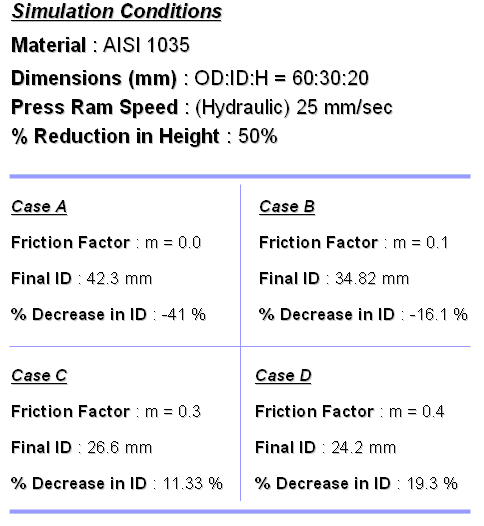
A ring test simulation will be preformed for two different friction shear factors, one material, one press setup. The simulation is
non-isothermal, therefore heat transfer at the interface is considered
The simulations show how temperature and shear friction factor affect metal flow and ring geometry. Compared to isothermal, non-isothermal
deformation causes the level of friction to increase.