
Comparison of Fibonacci Series Generation Using Iterative and Recursive Methods
1. Introduction
The Fibonacci series is one of the most famous numerical sequences in mathematics and computer science.
It appears in many real-world applications such as algorithm design, data structures, nature patterns, and problem-solving techniques.
In programming, the Fibonacci series is commonly used to understand:
- Looping concepts
- Function calls
- Recursion
- Time and space complexity comparison
Real-World Applications
- Used in algorithm analysis to explain recursion and dynamic programming
- Applied in data structures like trees and heaps
- Seen in nature patterns such as leaf arrangement and shell spirals
- Used in financial models for trend and ratio analysis
- Helpful in teaching problem-solving and optimization techniques
2. Definition of Fibonacci Series
The Fibonacci series is a sequence of numbers where each number is the sum of the previous two numbers.
Mathematical Definition:
- F(0) = 0
- F(1) = 1
- F(n) = F(n−1) + F(n−2) for n ≥ 2
Example:
0, 1, 1, 2, 3, 5, 8, 13, 21, ...
3. Methods to Generate Fibonacci Series
There are two commonly used programming approaches:
- Iterative Method
- Recursive Method
Each approach has its own advantages and disadvantages.
Dynamic programming bridges these two approaches by combining recursive problem decomposition with iterative-style reuse of previously computed results (memoization/tabulation).
4. Iterative Approach
Concept
The iterative approach generates the Fibonacci series using loops such as for or while.
It calculates each Fibonacci number step-by-step and stores only the required values.
Working Principle
- Initialize the first two numbers
- Use a loop to calculate the next terms
- Update values in each iteration
Pseudocode
          FibonacciIterative(n):
            if n == 0:
              return 0
            if n == 1:
              return 1

          a ← 0
          b ← 1

          for i ← 2 to n do
             c ← a + b
             a ← b
             b ← c
          end for

          return b   // nth Fibonacci number
Flowchart: Iterative Fibonacci
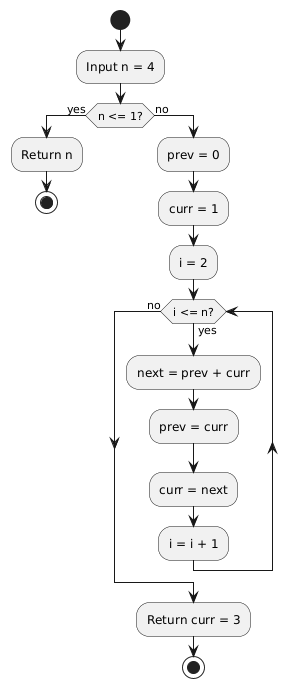
The flowchart illustrates the iterative process for finding 4th Fibonacci number.
Advantages
- Faster execution time
- Uses less memory
- Simple and efficient for large values of n
Disadvantages
- Logic may look less mathematical compared to recursion
5. Recursive Approach
Concept
The recursive approach uses function calls where a function calls itself to calculate Fibonacci numbers.
Working Principle
- The recursion stops at base cases (
n = 0andn = 1) - For other values, the function calls itself to compute the two previous Fibonacci numbers
- The final value is obtained by adding results of smaller subproblems
Pseudocode
          F(n):
            if n == 0:
                return 0
            if n == 1:
                return 1
            return F(n-1) + F(n-2)
Recursion Tree: Recursive Fibonacci
F(4)
          ├── F(3)
          │   ├── F(2)
          │   │   ├── F(1) = 1
          │   │   └── F(0) = 0
          │   └── F(1) = 1
          └── F(2)
            ├── F(1) = 1
            └── F(0) = 0
The recursion tree for F(4) shows repeated subproblems (for example, F(2) is computed multiple times), which causes inefficiency in naive recursion.
Advantages
- Simple and close to mathematical definition
- Easy to understand conceptually
Disadvantages
- Slower execution time due to repeated calculations
- Uses more memory space (stack calls)
- Inefficient for large values of n
6. Comparison: Iterative vs Recursive
| Feature | Iterative Approach | Recursive Approach |
|---|---|---|
| Execution Speed | Fast – computes each term once in a single pass | Slow – recalculates the same subproblems multiple times |
| Time Complexity | O(n) – linear growth with input size | Θ(φⁿ) where φ ≈ 1.618 – exponential growth due to overlapping subproblems |
| Space Complexity | O(1) – uses only a fixed number of variables | O(n) – requires stack space proportional to recursion depth |
| Memory Usage | Low – no additional stack frames needed | High – each recursive call adds a new frame to the call stack |
| Risk of Integer Overflow | Present for very large n with fixed-size integer types | Present for very large n with fixed-size integer types |
| Risk of Stack Overflow | None – no recursion involved | High – deep recursion for large n can exceed stack limit |
| Scalability | Highly scalable for large values of n | Not scalable – becomes impractical for n > 30–40 |
| Function Call Overhead | None – all computation happens within a single function | Significant – each call incurs overhead for stack management |
| Suitability for Optimization | Already optimal for basic Fibonacci | Can be optimized using memoization or dynamic programming |
| Best Use Case | Production code, large inputs, performance-critical applications | Teaching recursion concepts, small inputs, algorithm demonstrations |
Key Insights
- For practical applications, the iterative method is almost always preferred due to its efficiency and predictable performance.
- For educational purposes, the recursive method helps students understand the concept of breaking problems into smaller subproblems.
- Dynamic programming acts as a bridge between recursion and iteration: memoization preserves recursive thinking, while tabulation follows an iterative build-up.
- Optimization techniques like memoization can improve recursive performance to O(n), though recursive memoization may still carry stack overhead compared to pure iteration.
7. Time and Space Complexity
Iterative Method
- Time Complexity:
O(n)
The loop runs once for each value from0ton, performing a constant amount of work each time. - Space Complexity:
O(1)
Only a few variables are used, regardless of the value ofn.
Recursive Method (Naive)
- Time Complexity:
Θ(φⁿ)whereφ = (1 + √5)/2 ≈ 1.618
The number of recursive calls grows exponentially and is more tightly bounded by powers of the golden ratio than by2ⁿ. - Space Complexity:
O(n)
The maximum recursion depth isn, so the call stack grows linearly withn.
Practical Limitation: Integer Overflow
- With fixed-width integer types (for example, 32-bit or 64-bit), values eventually exceed the maximum representable limit.
- For large
n, use big integer libraries/types (such asBigInt) to avoid overflow.
8. Conclusion
Both iterative and recursive methods are important for learning programming concepts.
- Iterative approach is preferred for performance and real-world applications.
- Recursive approach is useful for understanding recursion and mathematical problem-solving.
Understanding both methods helps students choose the right approach based on the problem requirements.
For further reading, refer to: Fibonacci and Recurrences (Cornell CS2110)