
Quick Sort Experiment
Pivot Selection in QuickSort
QuickSort is a Divide and Conquer algorithm that works by selecting a 'pivot' element and partitioning the array around it. The choice of pivot significantly affects the algorithm's performance.
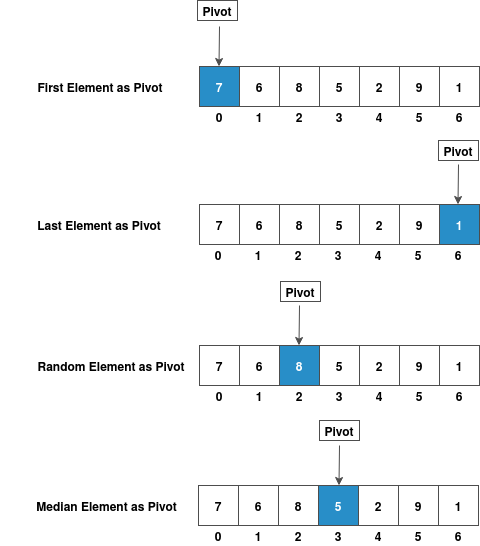
Common Pivot Selection Strategies
First Element as Pivot
- Simple to implement
- Poor performance on already sorted arrays
Last Element as Pivot
- Most commonly used in implementations
- Easy to understand and code
Random Element as Pivot
- Provides good average-case performance
- Helps avoid worst-case scenarios
Median as Pivot
- Best theoretical choice
- Requires additional computation to find median
Pictorial Representation of Pivot Selection
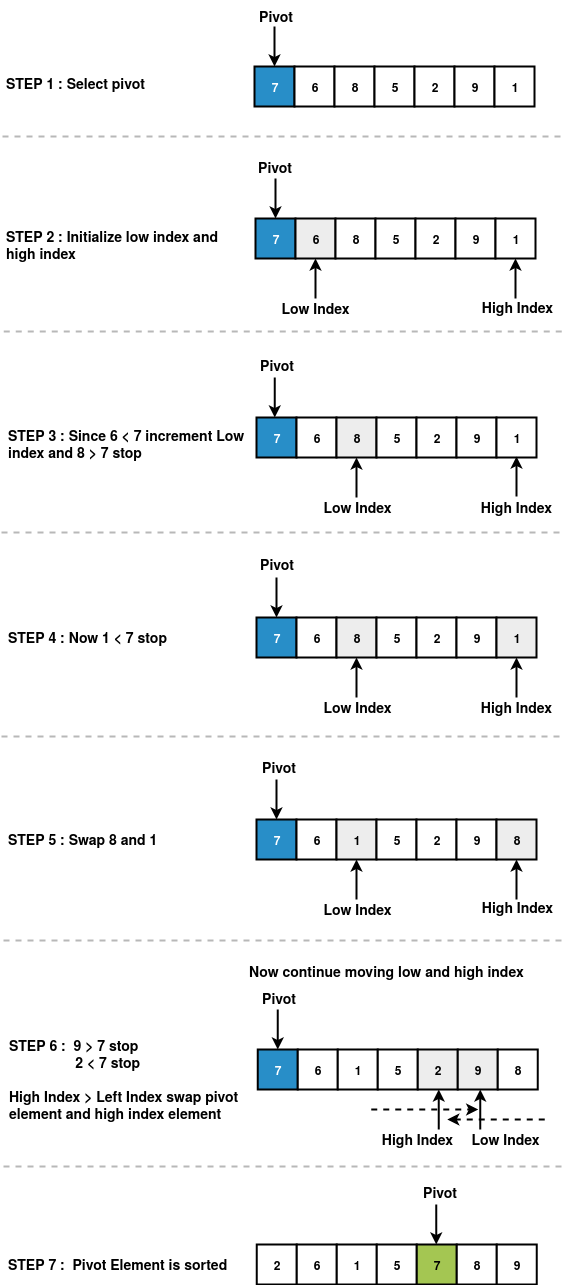
Array Partitioning Process
Goal: Given an array and a pivot element, rearrange the array so that:
- All elements ≤ pivot are on the left
- The pivot is in its correct sorted position
- All elements > pivot are on the right
Three-Part Division
After partitioning, the array is divided into three sections:
| Partition 1 | Partition 2 | Partition 3 |
|---|---|---|
| Elements ≤ pivot | Pivot element | Elements > pivot |
Partitioning Algorithm Steps
Step 1: Select Pivot
Choose a pivot using one of the strategies mentioned above.
Step 2: Initialize Pointers
- Low index (i): Points to the first element
- High index (j): Points to the last element (excluding pivot if it's the last element)
Step 3: Compare and Move Pointers
From the left (low index):
- If
array[i] ≤ pivot, moveiforward - If
array[i] > pivot, stop
From the right (high index):
- If
array[j] > pivot, movejbackward - If
array[j] ≤ pivot, stop
Step 4: Swap or Place Pivot
- If
i < j: Swaparray[i]andarray[j], then repeat Step 3 - If
i ≥ j: Partitioning is complete, place pivot at correct position
Step 5: Recursive Calls
Apply QuickSort recursively to both sub-arrays (left and right of the pivot).
Example Walkthrough
Initial Array: [64, 34, 25, 12, 22, 11, 90]
Pivot: 90 (last element)
- Initialize:
i = 0,j = 5(pointing to 11) - Compare: Move pointers until elements need swapping
- Partition: After processing:
[64, 34, 25, 12, 22, 11, 90] - Result: All elements ≤ 90 are on the left, 90 is in correct position
Pictorial Representation of Partitioning Process
Key Points to Remember
✅ Partitioning is the core operation in QuickSort
✅ Pivot choice affects performance - random selection often works well
✅ In-place partitioning uses constant extra space
✅ After partitioning, pivot is in its final sorted position
✅ Recursively apply to sub-arrays on both sides of pivot
Time Complexity
- Best/Average Case: O(n log n) - when pivot divides array roughly equally
- Worst Case: O(n²) - when pivot is always the smallest/largest element
- Space Complexity: O(log n) - due to recursive call stack