DNA sequence analysis and determining DNA open reading frames
Procedure to Work Simulator
Provide a DNA sequence in user interface for finding ORF. For example provide a hypothetical sequence CGCTACGTCTTACGCTGGAGCTCTCATGGATCGGTTCGGTAGGGCTCGATCACATCGCTAGCCAT
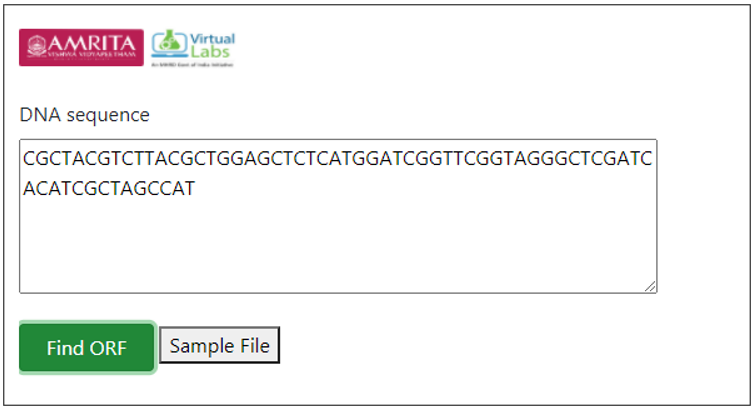
- Click on Find ORF tab for executing simulator.
- A default sequence file is provided in the user interface. User can download the file and can use the file as query sequence for finding ORF.
ORF is a continuous stretch of codons with a start codon usually AUG and with a stop codons usually UAA, UAG or UGA.
DIY
Import “stringr” library to R workspace
library("stringr")
Create function for finding Start and Stop codon
            findPotentialStartsAndStops<- function(sequence)
                        {
Define a vector with the sequences of potential start and stop codons
codons<- c("atg", "taa", "tag", "tga")
Find the number of occurrences of each type of potential start or stop codon
                    for (i in 1:4)
                            {
                                codon<- codons[i]
Find all occurrences of codon "codon" in sequence "sequence"
occurrences<- as.data.frame(str_locate_all(sequence,codon))
Find the start positions of all occurrences of "codon" in sequence "sequence"
codonpositions<- c(occurrences[[1]])
Find the total number of potential start and stop codons in sequence "sequence"
                numoccurrences<- length(codonpositions)
                            if (i == 1)
                            {
Make a copy of vector "codonpositions" called "positions"
positions<- codonpositions
Make a vector "types" containing "numoccurrences" copies of "codon"
            types<- rep(codon, numoccurrences)
                    }
                    else
                        {
Add the vector "codonpositions" to the end of vector "positions":
positions<- append(positions, codonpositions,after=length(positions))
Add the vector "rep(codon, numoccurrences)" to the end of vector "types":
        types<- append(types, rep(codon, numoccurrences),after=length(types))
                }
                }
Sort the vectors "positions" and "types" in order of position along the input sequence:
        indices<- order(positions)
                positions<- positions[indices]
                types<- types[indices]
Return a list variable including vectors "positions" and "types":
        mylist<- list(positions,types)
                return(mylist)
                }


                findORFsinSeq<- function(sequence)
                {
                require(Biostrings)
Make vectors "positions" and "types" containing information on the positions of ATGs in the sequence:
        mylist<- findPotentialStartsAndStops(sequence)
                positions<- mylist[[1]]
                types<- mylist[[2]]
Make vectors "orfstarts" and "orfstops" to store the predicted start and stop codons of ORFs
        orfstarts<- numeric()
                orfstops<- numeric()
Make a vector "orflengths" to store the lengths of the ORFs
orflengths<- numeric()
Print out the positions of ORFs in the sequence: Find the length of vector "positions"
numpositions<- length(positions)
There must be at least one start codon and one stop codon to have an ORF.
    if (numpositions>= 2){
            for (i in 1:(numpositions-1))
            {
            posi<- positions[i]
            typei<- types[i]
            found<- 0
            while (found == 0)
            {
            for (j in (i+1):numpositions)
            {
            posj<- positions[j]
            typej<- types[j]
            posdiff<- posj - posi
            posdiffmod3 <- posdiff %% 3
Add in the length of the stop codon
    orflength<- posj - posi + 3
            if (typei == "atg" && (typej == "taa" || typej == "tag" || typej== "tga") && posdiffmod3 == 0)
              {
Check if we have already used the stop codon at posj+2 in an ORF numorfs<- length(orfstops) usedstop<- -1 if (numorfs> 0) { for (k in 1:numorfs) { orfstopk<- orfstops[k] if (orfstopk == (posj + 2)) { usedstop<- 1 } } } if (usedstop == -1) { orfstarts<- append(orfstarts, posi,after=length(orfstarts)) orfstops<- append(orfstops, posj+2,after=length(orfstops)) # Including the stop codon. orflengths<- append(orflengths, orflength,after=length(orflengths)) } found<- 1 break } if (j == numpositions) { found <- 1 } } } } }
Sort the final ORFs by start position:
    indices<- order(orfstarts)
            orfstarts<- orfstarts[indices]
            orfstops<- orfstops[indices]
Find the lengths of the ORFs that we have
    orflengths<- numeric()
            numorfs<- length(orfstarts)
            for (i in 1:numorfs)
             {
                orfstart<- orfstarts[i]
                orfstop<- orfstops[i]
                orflength<- orfstop - orfstart + 1
                orflengths<- append(orflengths,orflength,after=length(orflengths))
                 }
                mylist<- list(orfstarts, orfstops, orflengths)
                return(mylist)
                }