
Simulation of sending live sensors data on IoT Platform using MQTT Protocols and ESP8266/ESP32
Objective
The objective of this experiment is to simulate and understand the process of sending live sensor data to an IoT cloud platform using the MQTT (Message Queuing Telemetry Transport) protocol with ESP8266 and ESP32 microcontrollers.
This experiment focuses on lightweight communication, publish–subscribe architecture, Quality of Service (QoS) levels, and real-time data transfer, which are critical concepts for large-scale and resource-constrained IoT systems.
Introduction
The Internet of Things (IoT) enables interconnected devices to collect, exchange, and analyze data over the internet. As IoT devices are often deployed in environments with limited bandwidth, low power availability, and unstable network conditions, efficient communication protocols are essential.
While HTTP follows a synchronous request–response communication model, it introduces overhead due to headers and repeated connections. To address these limitations, MQTT was specifically designed for IoT and machine-to-machine (M2M) communication. MQTT is a lightweight, event-driven, and bandwidth-efficient protocol that supports real-time data transmission with minimal resource usage.
This experiment demonstrates how ESP8266 and ESP32 use MQTT to publish live sensor data to an IoT platform, enabling scalable and reliable real-time monitoring.
ESP8266 and ESP32 as MQTT-Based IoT Nodes
ESP8266 and ESP32 are widely used in MQTT-based IoT systems due to the following features:
- Built-in Wi-Fi connectivity
- Integrated TCP/IP stack
- Compatibility with popular MQTT client libraries
- Low power consumption
- Ability to handle real-time sensor data efficiently
In this experiment, ESP8266 / ESP32 function as MQTT clients that acquire sensor data, format it into messages, and publish it to an MQTT broker over a Wi-Fi network.
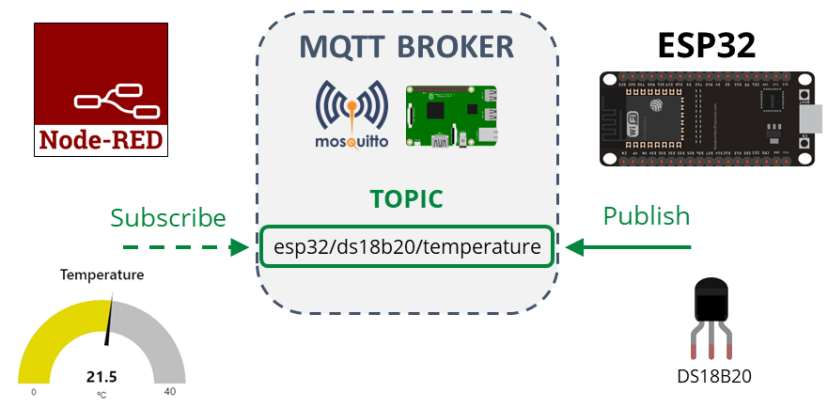
IoT System Architecture Using MQTT
An MQTT-based IoT system follows a decoupled communication architecture consisting of the following components:
Sensors
Sensors measure physical or environmental parameters such as temperature, humidity, gas concentration, or distance.ESP8266 / ESP32 (Publisher)
Reads sensor data, processes it, and publishes messages to MQTT topics.MQTT Broker
Acts as a central message hub that receives messages from publishers and distributes them to subscribers.Subscribers / IoT Dashboard
Subscribe to specific topics and receive sensor updates in real time.
Unlike HTTP, MQTT does not require direct communication between sender and receiver, making it highly scalable.
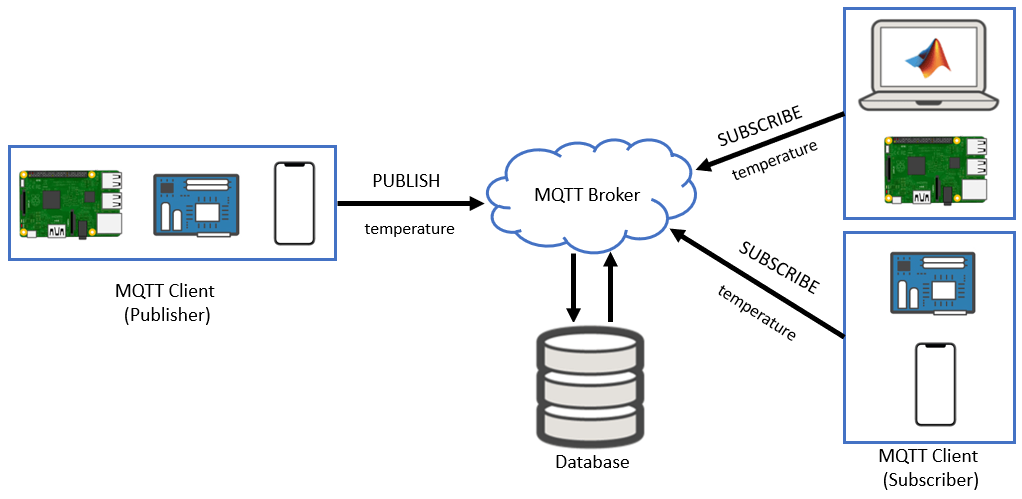
MQTT Protocol Overview
MQTT (Message Queuing Telemetry Transport) is a lightweight messaging protocol based on the publish–subscribe communication model. It runs over TCP/IP and is optimized for devices with limited processing power and memory.
Key Characteristics of MQTT
- Lightweight and bandwidth-efficient
- Asynchronous communication
- Runs over TCP/IP
- Supports unreliable networks
- Ideal for low-power IoT devices
MQTT is particularly suitable for:
- Remote monitoring systems
- Real-time sensor data streaming
- Large-scale IoT deployments
Publish–Subscribe Communication Model
Publisher
- ESP8266 / ESP32 publishes sensor data
- Messages are sent to a specific topic
Broker
- Receives messages from publishers
- Filters and routes messages based on topics
- Manages client connections
Subscriber
- Subscribes to one or more topics
- Automatically receives updates when new data is published
This model decouples data producers and consumers, improving scalability and system reliability.
MQTT Topics and Messages
MQTT uses topics to organize and filter messages.
- Topics are hierarchical strings
- Example topics:
lab/sensors/temperaturelab/sensors/humidity
Each MQTT message consists of:
- Topic – Identifies message category
- Payload – Contains sensor data
Payload formats may include:
- Plain text
- JSON
Structured topics enable scalable and organized IoT communication.
Sensor Data Acquisition and Publishing Process
The complete data flow in this experiment includes:
- Sensors are interfaced with ESP8266 / ESP32
- Sensor values are read using ADC or digital pins
- Raw data is processed and converted into meaningful units
- Sensor data is formatted into an MQTT payload
- Payload is published to a predefined MQTT topic
- Broker distributes data to subscribed clients
This process enables near real-time updates with minimal latency.
MQTT Broker and IoT Platform
An MQTT broker acts as the central server for message exchange.
Key Broker Functions
- Topic-based message routing
- Client authentication
- Session management
- Message persistence
IoT platforms using MQTT typically provide:
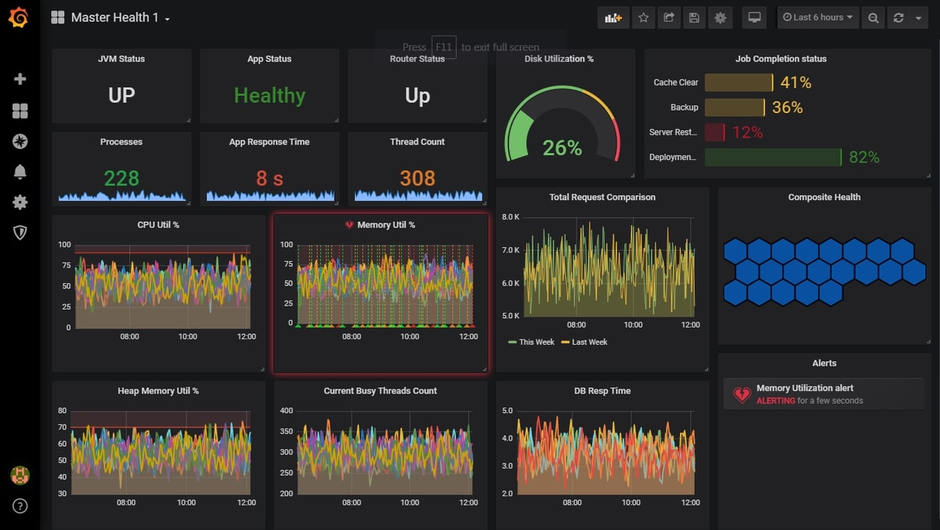
- Real-time dashboards
- Graphical data visualization
- Alerts and notifications
- Device and topic management
Common MQTT brokers and platforms include:
- Mosquitto
- HiveMQ
- EMQX
- Cloud-based IoT dashboards
Quality of Service (QoS) Levels in MQTT
MQTT provides three Quality of Service (QoS) levels to balance reliability and performance:
| QoS Level | Description |
|---|---|
| QoS 0 | At most once – Fast delivery, no guarantee |
| QoS 1 | At least once – Guaranteed delivery |
| QoS 2 | Exactly once – Highest reliability |
QoS selection depends on application requirements such as latency tolerance and reliability needs.
Security Considerations in MQTT Communication
MQTT-based IoT systems require proper security mechanisms to prevent unauthorized access and data breaches.
Common security techniques include:
- Client authentication using username and password
- TLS/SSL encryption for secure communication
- Access control on MQTT topics
Although basic simulations may not implement full security, understanding these concepts is essential for real-world IoT deployments.
Applications of MQTT-Based IoT Systems
MQTT is widely used in various IoT domains, including:
- Smart agriculture monitoring
- Industrial IoT (IIoT) systems
- Smart home automation
- Environmental monitoring platforms
- Healthcare IoT solutions
Conclusion
This experiment provides an in-depth understanding of MQTT-based IoT communication using ESP8266 and ESP32 microcontrollers. It highlights the advantages of the publish–subscribe model, lightweight communication, and QoS mechanisms, making MQTT a preferred protocol for scalable and real-time IoT applications.
References
- MQTT Version 3.1.1 Specification – OASIS
- Espressif Systems ESP8266 & ESP32 Documentation
- IoT Communication Protocols – IEEE
- HiveMQ MQTT Essentials Guide
- Internet of Things: Principles and Paradigms – Rajkumar Buyya