Lesson 3: Smithy (Hand Forging)
📥 Lesson 3 DownloadIntroduction
Forging is also referred as smithy when the shaping of small jobs is carried out at small scale by manual hammering and heating the workpiece in an open fire or hearth.
3.1 Equipments of a Smithy Shop
The equipments for a smithy shop are relatively simple as the production of good quality work depends on the skill of the worker.
- Hearth or fire
- Blower
- Blacksmith's Anvil
- Bick Iron
- Blacksmith's Swage block
- One steam or pressure hammer
- Trough of water
Hearth or fire
The metal to be worked is heated in a hearth in which the coke fire is lit by means of air admitted through the tuyere (nozzle) under a slight pressure by means of a blower. A trough of water is kept alongside for cooling the tools.
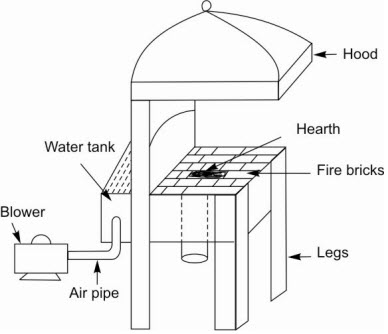
Figure 1: Hearth or fire and accessories (shovel and vent wire)
Blacksmith's anvils
Purpose of blacksmith's anvil is to provide a working surface for supporting the metal when it is being forged, shaped and punched for holes. It features a flat face, a horn for forming curved shapes, a pritchet hole for punching/bending small rods, and a hardie hole for holding square shanks of various fittings.
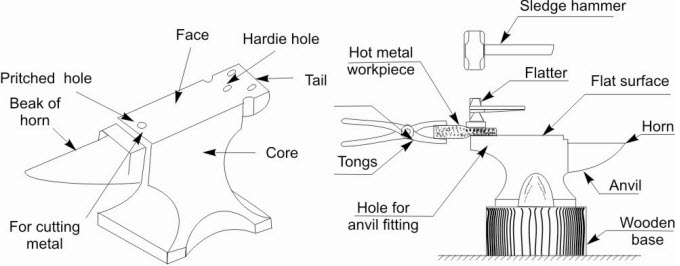
Figure 2: Anvil
Bick Iron and Swage Block
A bick iron is a type of small anvil specifically used for working on small jobs. The swage block facilitates the shaping, sizing, and smoothing of round, square, and hexagon sections from the rough bar of metal.
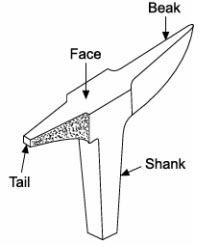
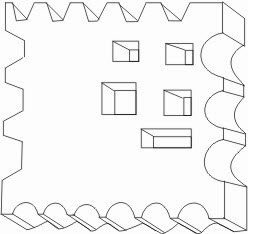
Figure 3: Bick iron | Figure 4: Swage block
3.2 Types of iron working tools
Tools used in a smithy shop are classified by function: Striking, Holding, Cutting, Punching/Drilling, Forming/Finishing, and Measuring/Testing.
3.2.1 Striking tools
Striking tools are used to hammer the work directly or indirectly. Types include Double faced, Straight peen, Cross peen, Ball peen, and Smith's hammers. The handle length is usually 35 to 40 cm.
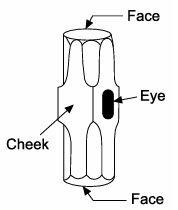
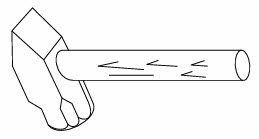
Figure 5: Striking tools
3.2.2 Holding tools
Tongs are used to grip the hot or cold workpiece firmly. Types include Flat, Hollow bit (for square/round), Square clip, Angle, Link, and Pick-up tongs. Lengths vary from 45 to 65 cm.
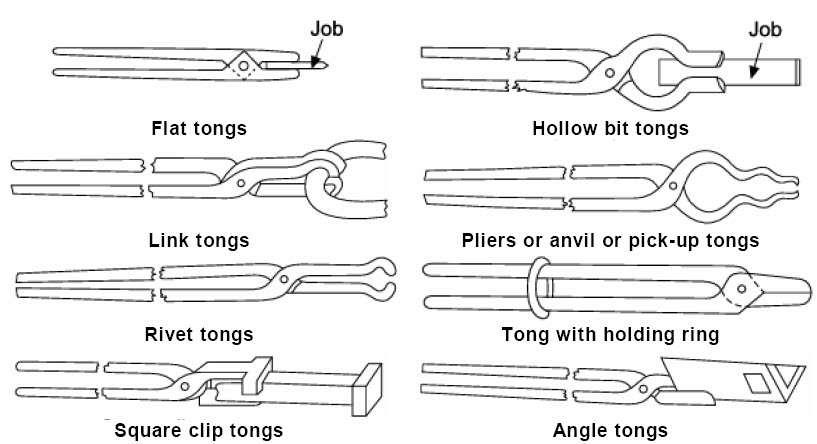
Figure 6: Holding tools
3.2.4 Cutting tools
Used for cutting and marking work. Hot chisels (30°) are used for hot metal, while cold chisels (60°) are used for cold working. Anvil cutters (Hardies) fit into the square hole of the anvil.
3.2.6 Forming and finishing tools
- Swages: Top and bottom tools used for forming shapes like round or hexagonal.
- Fullers: Used for necking and drawing down a forging to a smaller size.
- Flatter: Used for smoothing and finishing flat surfaces.
- Set Hammer: Used for setting down metal to form square corners.
3.3 Smithy operations
3.5 Use and care of Smithy Tools
- The top face and horn of the anvil must be kept smooth and clean.
- Flatters, fullers, and swages must be kept properly ground and shaped.
- Cover tools and the anvil with a thin film of oil after use to prevent rusting.
3.6 Safety Precautions
- Use extreme care to prevent metal chips and hot sparks from causing injury or fires.
- Wear goggles to protect eyes, especially during shaping and cutting operations.