
To create IoT Application using LORAWAN and ESP8266/ESP32
Objective
The objective of this experiment is to simulate and understand the development of an IoT application using LoRaWAN technology with ESP8266 / ESP32 microcontrollers.
This experiment focuses on long-range, low-power wireless communication, LoRaWAN network architecture, and the interaction between end nodes, gateways, network servers, and application servers. It enables learners to understand how large-scale IoT networks operate efficiently over long distances.
Introduction
Traditional IoT communication technologies such as Wi-Fi, Bluetooth, and cellular networks are not always suitable for long-range and low-power IoT applications. These technologies either consume high power, have limited range, or incur high operational costs.
To overcome these limitations, LoRa (Long Range) and LoRaWAN (Long Range Wide Area Network) technologies have been developed. LoRaWAN is specifically designed for IoT applications that require long communication range, low data rate, and ultra-low power consumption.
LoRaWAN-based IoT systems are widely used in applications such as smart agriculture, smart cities, environmental monitoring, asset tracking, and industrial IoT, where devices are deployed in remote areas and are often battery-powered.
Overview of LoRa Technology
LoRa is a physical layer (PHY) wireless communication technology based on Chirp Spread Spectrum (CSS) modulation.
Key Characteristics of LoRa
- Long communication range (up to several kilometers)
- Low data rate
- High resistance to noise and interference
- Ultra-low power consumption
LoRa defines how data is transmitted wirelessly, including modulation and signal characteristics. However, LoRa alone does not define how devices are authenticated, managed, or secured within a network.
Overview of LoRaWAN Technology
LoRaWAN is a network and application layer protocol built on top of the LoRa physical layer. It defines the complete network behavior and communication rules for IoT systems.
LoRaWAN specifies:
- Network architecture
- Device authentication mechanisms
- End-to-end data encryption
- Communication scheduling and rules
LoRaWAN enables large-scale IoT deployments involving thousands of devices while maintaining low power consumption and secure communication.
LoRa vs LoRaWAN
| Feature | LoRa | LoRaWAN |
|---|---|---|
| Layer | Physical Layer | Network & Application Layer |
| Function | Radio modulation | Network management |
| Security | Not defined | AES-128 encryption |
| Device Management | Not supported | Fully supported |
| Scalability | Limited | Highly scalable |
| Typical Use Case | Point-to-point | Large IoT networks |
Summary:
LoRa defines how data is transmitted, while LoRaWAN defines how devices communicate securely and efficiently within a network.
Role of ESP8266 / ESP32 in LoRaWAN Systems
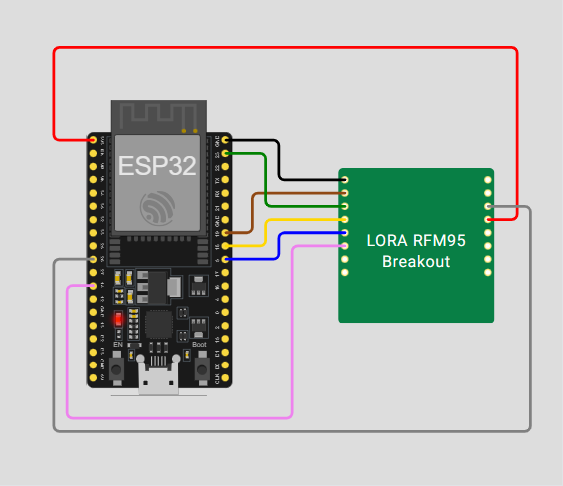
In LoRaWAN-based IoT applications, ESP8266 / ESP32 act as end-node controllers.
They perform the following tasks:
- Interface with sensors to collect data
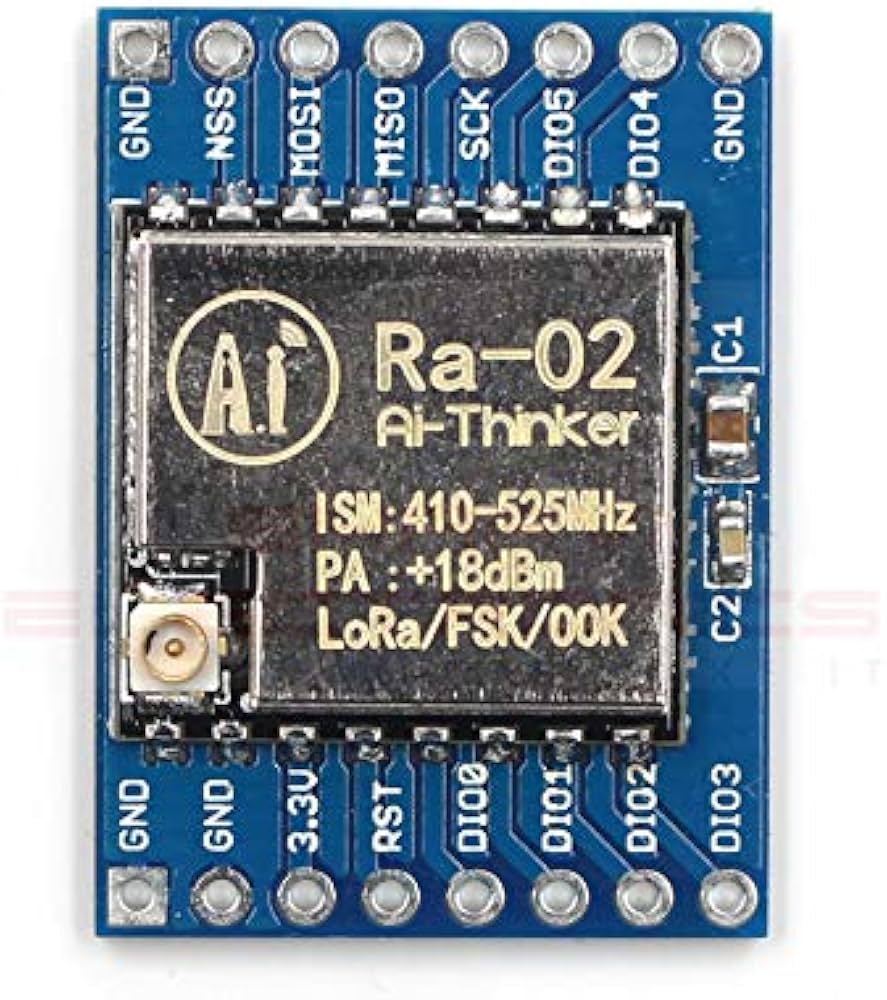
- Communicate with LoRa transceivers such as SX1276 / SX1278
- Format and transmit sensor data over LoRaWAN
- Manage low-power operation modes
ESP32 is often preferred due to:
- Higher processing capability
- Better power management features
- Multiple peripheral interfaces
LoRaWAN Network Architecture
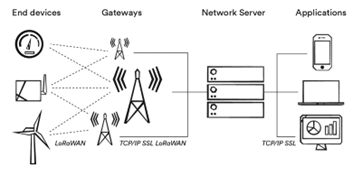
A LoRaWAN network follows a star-of-stars topology and consists of four major components:
- End Node (End Device)
- Gateway
- Network Server
- Application Server
Each component plays a specific role in enabling scalable and secure communication.
End Node (LoRaWAN Device)
Definition
An End Node is a low-power IoT device that:
- Collects sensor data
- Transmits data using LoRa modulation
- Operates on battery power for long durations
Characteristics
- Ultra-low power consumption
- Sends small data payloads
- Communicates only with gateways
In this experiment, ESP8266 / ESP32 combined with a LoRa module acts as the LoRaWAN end node.
LoRaWAN Gateway
Definition
A LoRaWAN Gateway acts as a bridge between:
- LoRaWAN end nodes
- Internet-based network servers
Functions
- Receives LoRa packets from end nodes
- Forwards data to the network server using IP networks (Ethernet / Wi-Fi / Cellular)
- Does not decrypt application payload
Gateways enable long-range communication and allow multiple end nodes to connect to the network simultaneously.
Network Server
Role of the Network Server
The Network Server is the core intelligence of the LoRaWAN system. It performs critical network-level operations such as:
- Device authentication
- Packet deduplication
- Network-level security enforcement
- Adaptive Data Rate (ADR) control
Examples of Network Servers
- The Things Stack
- ChirpStack
Application Server
The Application Server is responsible for handling application-level data.
It performs:
- Decryption of application payload
- Processing and storage of sensor data
- Visualization using dashboards
- Sending commands back to end devices (downlink)
This is the layer where users interact with IoT data.
LoRaWAN Data Flow
The complete LoRaWAN data flow is as follows:
- End node collects and sends sensor data
- Gateway receives LoRa packet
- Gateway forwards data to network server
- Network server processes and validates packet
- Application server stores and visualizes data
This architecture supports both uplink (device → cloud) and downlink (cloud → device) communication.
Advantages of LoRaWAN-Based IoT Applications
LoRaWAN offers several advantages:
- Very long communication range
- Ultra-low power consumption
- Secure end-to-end communication
- Highly scalable network architecture
- Ideal for remote and battery-powered deployments
Applications of LoRaWAN
LoRaWAN is widely used in:
- Smart agriculture systems
- Smart city infrastructure
- Environmental monitoring
- Asset tracking solutions
- Industrial IoT applications
Conclusion
This experiment provides a comprehensive understanding of building an IoT application using LoRaWAN and ESP8266 / ESP32. By studying LoRa technology, LoRaWAN architecture, and data flow, learners gain essential knowledge required to design scalable, secure, and energy-efficient IoT systems for real-world applications.
References
[1] LoRa Alliance, “LoRaWAN 1.1 Specification Overview.” [Online]. Available: https://lora-alliance.org
[2] The Things Network, “LoRaWAN Device Activation Methods.” [Online]. Available: https://www.thethingsnetwork.org/docs
[3] Espressif Systems, “ESP32 Documentation: LoRa Communication Basics.” [Online]. Available: https://docs.espressif.com
[4] S. Mistry, “LoRa and LoRaWAN for Arduino.” GitHub Documentation, 2020.
[5] Microchip Technology Inc., “AN1200.22: LoRa Modulation Basics.” Microchip Application Note, 2019.