
Demonstrate Connection Management Procedures
1. 5G Connection Management (CM)
Connection Management (CM) is one of the fundamental Non-Access Stratum (NAS) functions in the 5G Core network. It defines how a User Equipment (UE) establishes, maintains, suspends, and resumes signaling connectivity with the Access and Mobility Management Function (AMF).
This connectivity is required not only for user data delivery but also for several important network procedures such as registration updates, authentication, policy enforcement, session management signaling, and mobility handling.
Compared to 4G LTE, 5G introduces a more efficient design by adopting a Service-Based Architecture (SBA). In this architecture, the control plane (AMF) and user plane (UPF) are separated, allowing flexible management of signaling and data traffic.
To optimize resource usage, the UE signaling connectivity is controlled through two major procedures:
- Service Request Procedure — transitions UE from CM-IDLE → CM-CONNECTED
- UE Context Release Procedure — transitions UE from CM-CONNECTED → CM-IDLE
Understanding these procedures is important for analyzing UE behavior, network resource management, and signaling operations in 5G networks.
2. CM States in 5G
In the 5G Core network, Connection Management (CM) states describe the signaling connectivity between the UE and the AMF.
5G defines two primary CM states that control the UE's connectivity behavior.
2.1 CM-IDLE State
In the CM-IDLE state, the UE does not maintain an active NAS signaling connection with the AMF.
This state is similar to idle mode in LTE, but 5G introduces improvements such as optimized paging mechanisms, tracking area management, and RRC Inactive mode.
When the UE is in CM-IDLE:
- No dedicated RRC connection exists between the UE and the gNB.
- The AMF stores only minimal UE context information.
- The UE performs cell reselection autonomously.
- The UE monitors paging channels for incoming data.
- The UE can access the network through Random Access Channel (RACH) when needed.
The CM-IDLE state helps:
- Reduce network signaling overhead
- Save radio resources
- Lower UE power consumption
2.2 CM-CONNECTED State
In the CM-CONNECTED state, the UE maintains an active signaling connection with the network.
When the UE is in CM-CONNECTED:
- The UE has an active RRC connection with the gNB.
- The AMF maintains a complete UE context including security keys and session information.
- The UE can immediately send or receive NAS signaling and user-plane data.
- The gNB stores UE-specific RRC configurations and Data Radio Bearers (DRBs).
- Handover procedures occur when the UE moves between cells.
Although this state enables continuous communication, it consumes more radio resources and battery power. Therefore the network transitions the UE back to CM-IDLE when communication is not required.
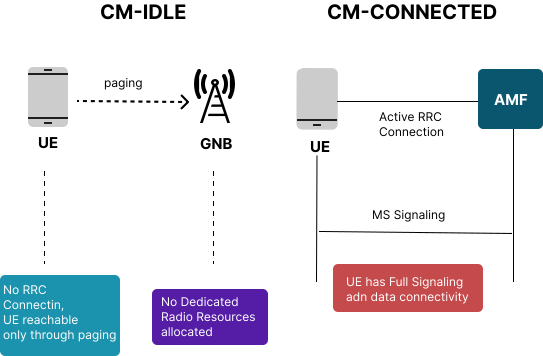
Fig: CM-IDLE vs CM-CONNECTED State Diagram
3. Service Request Procedure (CM-IDLE → CM-CONNECTED)
The Service Request procedure restores the UE's signaling connectivity and user-plane paths after they have been released due to inactivity.
This procedure frequently occurs in real networks because many applications generate short bursts of traffic.
3.1 Why Service Request Is Required
When the UE is in CM-IDLE:
- UE cannot send uplink data immediately
- gNB does not maintain RRC context
- Downlink traffic requires paging
Therefore a Service Request is required before communication resumes.
3.2 Types of Service Request
Mobile-Originated (MO) Service Request
Triggered by the UE when:
- Opening an application
- Sending uplink data
- Resuming PDU sessions
- Initiating NAS signaling
Mobile-Terminated (MT) Service Request
Triggered by the network when downlink data arrives.
Sequence:
- Data arrives at UPF
- UPF notifies SMF
- SMF informs AMF
- AMF performs paging
- UE responds with Service Request
3.3 Service Request Signaling Flow
Step 1: RRC Connection Establishment
Messages:
- RRC Connection Request
- RRC Connection Setup
- RRC Connection Setup Complete
The final message contains the NAS Service Request.
Step 2: NAS Forwarding
The gNB forwards the NAS message to the AMF via N2 interface.
AMF identifies UE using:
- 5G-GUTI
- Stored mobility context
Step 3: Security Validation
AMF performs:
- NAS security verification
- Retrieval of PDU session context
- Authorization validation
Step 4: SMF Coordination
If user-plane resources were released:
- AMF contacts SMF
- SMF re-establishes N3 tunnel
- gNB prepares DRBs
Step 5: Data Bearer Setup
AMF sends:
PDU Session Resource Setup Request
gNB responds:
PDU Session Resource Setup Response
Step 6: UE Becomes CM-CONNECTED
Signaling and data paths are restored.
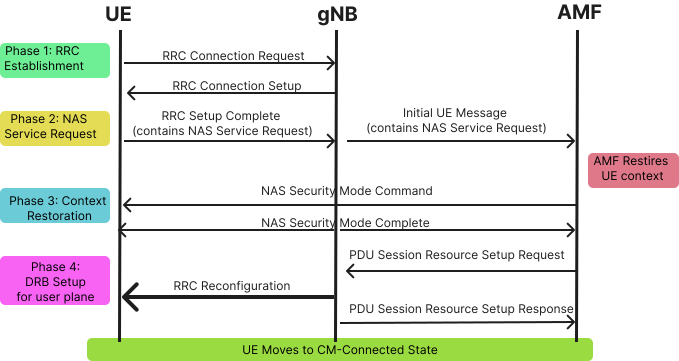
Fig: 5G Service Request Signaling Flow
4. UE Context Release Procedure (CM-CONNECTED → CM-IDLE)
The UE Context Release procedure moves the UE from CM-CONNECTED to CM-IDLE when communication is no longer required.
4.1 Why UE Context Release Is Necessary
Maintaining CM-CONNECTED consumes:
- Radio resources
- AMF processing power
- UE battery
- Network memory
Most devices send data only occasionally, so the network releases resources during inactivity.
4.2 Trigger Conditions
Inactivity Timer Expiry
Most common trigger when no activity occurs.
UE-Initiated Deregistration
Occurs when UE powers off or enables airplane mode.
Abnormal Conditions
Examples include radio link failure or handover failure.
Policy-Based Release
Operators may configure special policies (e.g., IoT devices).
4.3 UE Context Release Flow
Step 1: AMF Command
UE Context Release Command (AMF → gNB)
Step 2: gNB Releases Connection
gNB sends RRC Release to UE.
UE enters RRC-IDLE.
Step 3: Confirmation
gNB sends:
UE Context Release Complete
Step 4: UE Moves to CM-IDLE
AMF keeps minimal context:
- Tracking Area
- Paging data
- 5G-GUTI
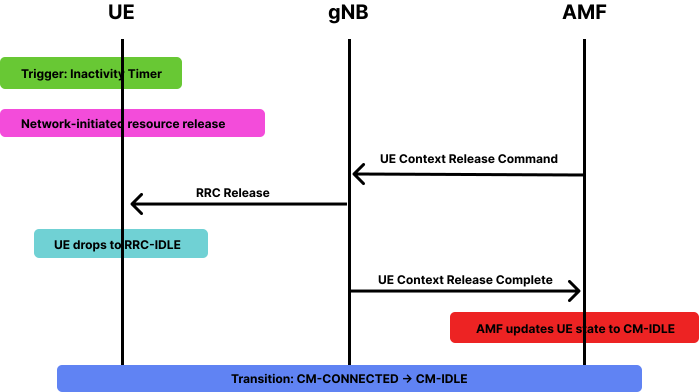
Fig: UE Context Release Signaling Flow