
Autoencoders for Representation Learning
Theory
Introduction to Autoencoders
Autoencoders are a type of neural network used for unsupervised learning of efficient data representations. Unlike supervised learning methods that require labelled data, autoencoders learn useful features by attempting to reconstruct their input. The main idea is to compress the input into a lower-dimensional representation and then reconstruct the original input from this compressed form using an encoder–decoder architecture.
"High-dimensional data can be converted to low-dimensional codes by training a multilayer neural network with a small central layer to reconstruct high-dimensional input vectors."
- Hinton & Salakhutdinov, Science, 2006
An autoencoder consists of two main parts:
- Encoder: Compresses the input into a latent-space representation (bottleneck layer)
- Decoder: Reconstructs the input from the latent representation
The network is trained to minimise the difference between the input and its reconstruction, forcing it to learn the most important features of the data.
Types of Autoencoders:
Basic Autoencoder:
A basic autoencoder learns to compress and reconstruct clean input data. The input image is passed through the encoder, compressed into a bottleneck (latent) representation, and then reconstructed by the decoder. The bottleneck layer forces the network to learn a compressed representation that captures the essential features of the input while discarding redundant information.
Denoising Autoencoder:
A denoising autoencoder is trained to reconstruct a clean image from a corrupted version of the same image. If the clean input is represented as , then the noisy input can be written as:
where is random noise. The noisy image is given as input to the model, but the target output remains the original clean image . The model learns to remove the noise and recover the underlying structure of the image. This helps the autoencoder learn features that are robust to corruption and useful for practical reconstruction tasks.
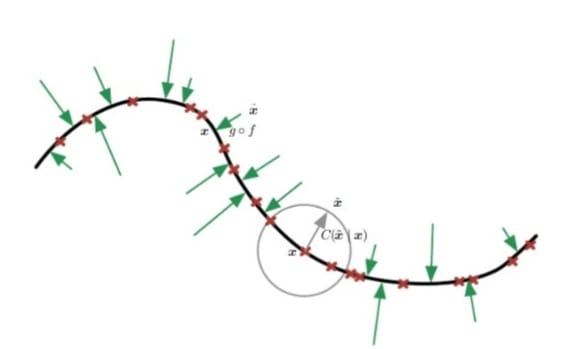
Figure 1- Denoising autoencoder (Source: Deep Learning. Ian Goodfellow, Yoshua Bengio, and Aaron Courville, MIT Press.)
The training process for a denoising autoencoder can be written as:
Input: (noisy image)
Target: (clean image)
Loss:
The reconstruction loss is computed by comparing the decoder's output with the original clean image. This forces the network to learn features that are resilient to noise and capture the underlying structure of the data.
Latent Space Representation:
The latent space (bottleneck layer) is the compressed representation learned by the encoder. It is the stacked layers in the encoder, its depth, that enable autoencoders to learn hierarchical representations of data, where early layers capture low-level features (such as edges and textures) and deeper layers capture increasingly abstract patterns. The bottleneck itself plays a separate but equally important role: by constraining the dimensionality, it forces the network to retain only the most essential information and discard redundancy.
For visualisation purposes, a 2-dimensional latent space is often used. When the latent dimension is 2, the encoded representations of input images can be directly plotted as a scatter plot to observe how the autoencoder organises different patterns in the data.
Similar fashion items tend to cluster together in the learned latent space, indicating that the autoencoder has learned meaningful and discriminative representations.
Fashion-MNIST Dataset
Fashion-MNIST is a dataset of grayscale images representing 10 different fashion categories. Each image is pixels. The 10 classes are:
- T-shirt/top
- Trouser
- Pullover
- Dress
- Coat
- Sandal
- Shirt
- Sneaker
- Bag
- Ankle boot
This dataset is commonly used for testing machine learning algorithms because it is more challenging than standard MNIST digits while maintaining the same image format.
Merits of Autoencoders
- Unsupervised Learning: No labelled data required for training
- Dimensionality Reduction: Learns compact representations of high-dimensional data
- Noise Reduction: Denoising autoencoders can remove noise from corrupted data
- Feature Learning: Automatically discovers useful features without manual engineering
- Data Compression: Can be used for efficient data storage and transmission
Demerits of Autoencoders
- Reconstruction Quality: May not perfectly reconstruct complex images
- Training Complexity: Requires careful tuning of architecture and hyperparameters
- Computational Cost: Deep autoencoders require significant training time
- Task-Specific: Representations learned may not transfer well to other tasks